Writer: Farniza M. Marcaban
Graphics and Layout:: Ricky John E. Ocapan| Information and Public Affairs Office
➢ 𝐒𝐭𝐫𝐚𝐭𝐞𝐠𝐢𝐜 𝐚𝐧𝐝 𝐀𝐝𝐦𝐢𝐧𝐢𝐬𝐭𝐫𝐚𝐭𝐢𝐯𝐞 𝐋𝐞𝐚𝐝𝐞𝐫𝐬𝐡𝐢𝐩
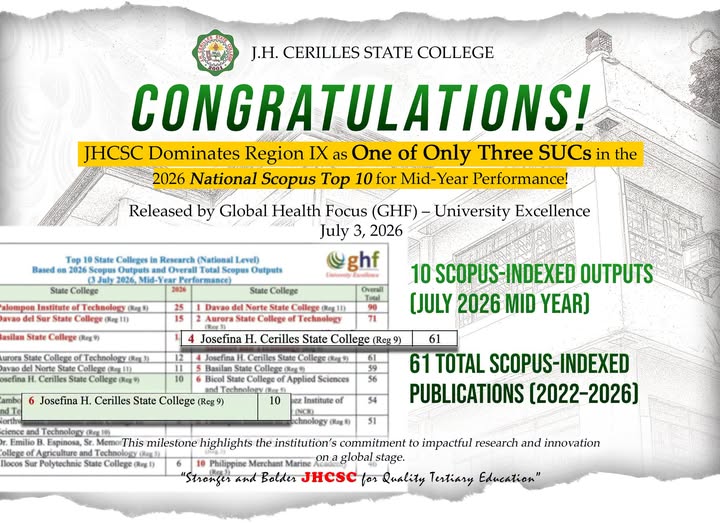
This historic research surge was fueled by visionary governance and aggressive administrative support, which played a vital role in elevating JHCSC’s position in global databases:
● 𝐃𝐫. 𝐄𝐝𝐠𝐚𝐫𝐝𝐨 𝐇. 𝐑𝐨𝐬𝐚𝐥𝐞𝐬 (College President) – Spearheads institutional financial grants, research incentives, and international journal publication rewards for faculty members, successfully institutionalizing a thriving culture of world-class research and innovation.
● 𝐃𝐫. 𝐌𝐚𝐫𝐤 𝐄. 𝐏𝐚𝐭𝐚𝐥𝐢𝐧𝐠𝐡𝐮𝐠 (Vice President for Research, Extension, and Resource Generation) – Directly manages the implementation of state-funded research and development projects, driving the institutional vetting process to ensure quality, high-impact research outputs.
● 𝐃𝐫. 𝐉𝐞𝐫𝐫𝐲 𝐁. 𝐒𝐮𝐩𝐞𝐫𝐚𝐥𝐞𝐬 (Former Vice President for Research, Extension, and Resource Generation) – Provided foundational oversight and structural guidance that catalyzed the institution’s multi-year research development strategy.
➢ 𝐓𝐨𝐩 𝐂𝐨𝐧𝐭𝐫𝐢𝐛𝐮𝐭𝐨𝐫𝐬 𝐃𝐫𝐢𝐯𝐢𝐧𝐠 𝐭𝐡𝐞 𝐈𝐧𝐬𝐭𝐢𝐭𝐮𝐭𝐢𝐨𝐧’𝐬 𝐇𝐢𝐬𝐭𝐨𝐫𝐢𝐜 𝐒𝐜𝐨𝐩𝐮𝐬 𝐏𝐨𝐫𝐭𝐟𝐨𝐥𝐢𝐨
The primary scholarly engines behind the institution’s 2026 Scopus-indexed research breakthroughs, along with the specific United Nations Sustainable Development Goals (SDGs) their work directly advances, include:
● 𝐃𝐫. 𝐒𝐭𝐚𝐫𝐫 𝐂𝐥𝐲𝐝𝐞 𝐋𝐮𝐦𝐚𝐧𝐭𝐚 𝐒𝐞𝐛𝐢𝐚𝐥
• Contribution: The institution’s top-performing author for Q1 Scopus-indexed metrics, spearheading high-impact international sociology and education publications, including landmark studies published in Frontiers in Sociology and Springer’s Disciplinary and Interdisciplinary Science Education Research.
• Primary SDGs Addressed: SDG 4 (Quality Education), SDG 5 (Gender Equality), and SDG 10 (Reduced Inequalities) through her framework validations on Gender Equity, Diversity, and Inclusivity (GEDI) and AI integration in STEM education.
● 𝐃𝐫. 𝐌𝐚𝐫𝐤 𝐄. 𝐏𝐚𝐭𝐚𝐥𝐢𝐧𝐠𝐡𝐮𝐠
• Contribution: Specializes in international bibliometric mapping, mixed-methods frameworks, and systemic reviews focusing on global and regional trends in crime prevention, public safety, and sociological research.
• Primary SDGs Addressed: SDG 16 (Peace, Justice, and Strong Institutions) and SDG 11 (Sustainable Cities and Communities) via his targeted institutional assessments on governance, public safety, and community extension frameworks.
● 𝐃𝐫. 𝐇𝐚𝐢𝐝𝐞𝐞 𝐅𝐮𝐞𝐧𝐭𝐞𝐬 𝐏𝐚𝐭𝐚𝐥𝐢𝐧𝐠𝐡𝐮𝐠
• Contribution: Senior researcher exploring graduate school studies, administrative extension operations, and institutional data tracking to enhance faculty research productivity.
• Primary SDGs Addressed: SDG 4 (Quality Education) and SDG 8 (Decent Work and Economic Growth) by optimizing human capital, teacher education tracking, and academic operational efficiency.
● 𝐃𝐫. 𝐌𝐨𝐢𝐬𝐞𝐬 𝐆𝐥𝐞𝐧𝐧 𝐆. 𝐓𝐚𝐧𝐠𝐚𝐥𝐢𝐧
• Contribution: High-level agricultural researcher, Dumingag Campus Director, and Research Director. He leads vital field innovations, notably the acclaimed state-funded “ZamPen Native Chicken Project R&D Facility,” alongside indexed work addressing regional agricultural supply constraints, livestock technologies, and crop optimization.
• Primary SDGs Addressed: SDG 1 (No Poverty), SDG 2 (Zero Hunger), and SDG 15 (Life on Land) by developing climate-resilient organic agriculture, enhancing localized food security frameworks, and generating sustainable livelihoods for local farming communities.
● 𝐃𝐫. 𝐏𝐚𝐮𝐥𝐢𝐧𝐨 𝐑. 𝐓𝐚𝐠𝐚𝐲𝐥𝐨
• Contribution: Collaborative researcher focusing on PRISMA-based systematic reviews analyzing institutional factors, policy enforcement, and integrity infrastructure in higher education.
• Primary SDGs Addressed: SDG 16 (Peace, Justice, and Strong Institutions) through rigorous data modeling centered on policy compliance, institutional transparency, and academic integrity infrastructures.
● 𝐏𝐫𝐨𝐟. 𝐉𝐮𝐦𝐚𝐫 𝐁. 𝐓𝐚𝐨𝐭𝐨-𝐚𝐧
• Contribution: Lead researcher and co-author specializing in educational frameworks, structural academic pressures, and institutional resource development.
• Primary SDGs Addressed: SDG 4 (Quality Education) by developing modern pedagogical models designed to optimize learning conditions and structural support systems in higher education.
● 𝐃𝐫. 𝐁𝐞𝐧𝐣𝐚𝐦𝐢𝐧 𝐁. 𝐌𝐚𝐧𝐠𝐢𝐥𝐚
• Contribution: Primary researcher in linguistics and education, recently publishing peer-reviewed work analyzing structural and linguistic features in educational textbooks.
• Primary SDGs Addressed: SDG 4 (Quality Education) and SDG 10 (Reduced Inequalities) through his critical analyses of linguistic features, cultural preservation, and institutionalizing Mother Tongue-Based multilingual settings to empower diverse student bodies.
Soar high, J.H. Cerilles State College!
“Stronger and Bolder JHCSC for Quality Tertiary Education”