Writer: Farniza M. Marcaban
Graphics and Layout: Ricky John E. Ocapan
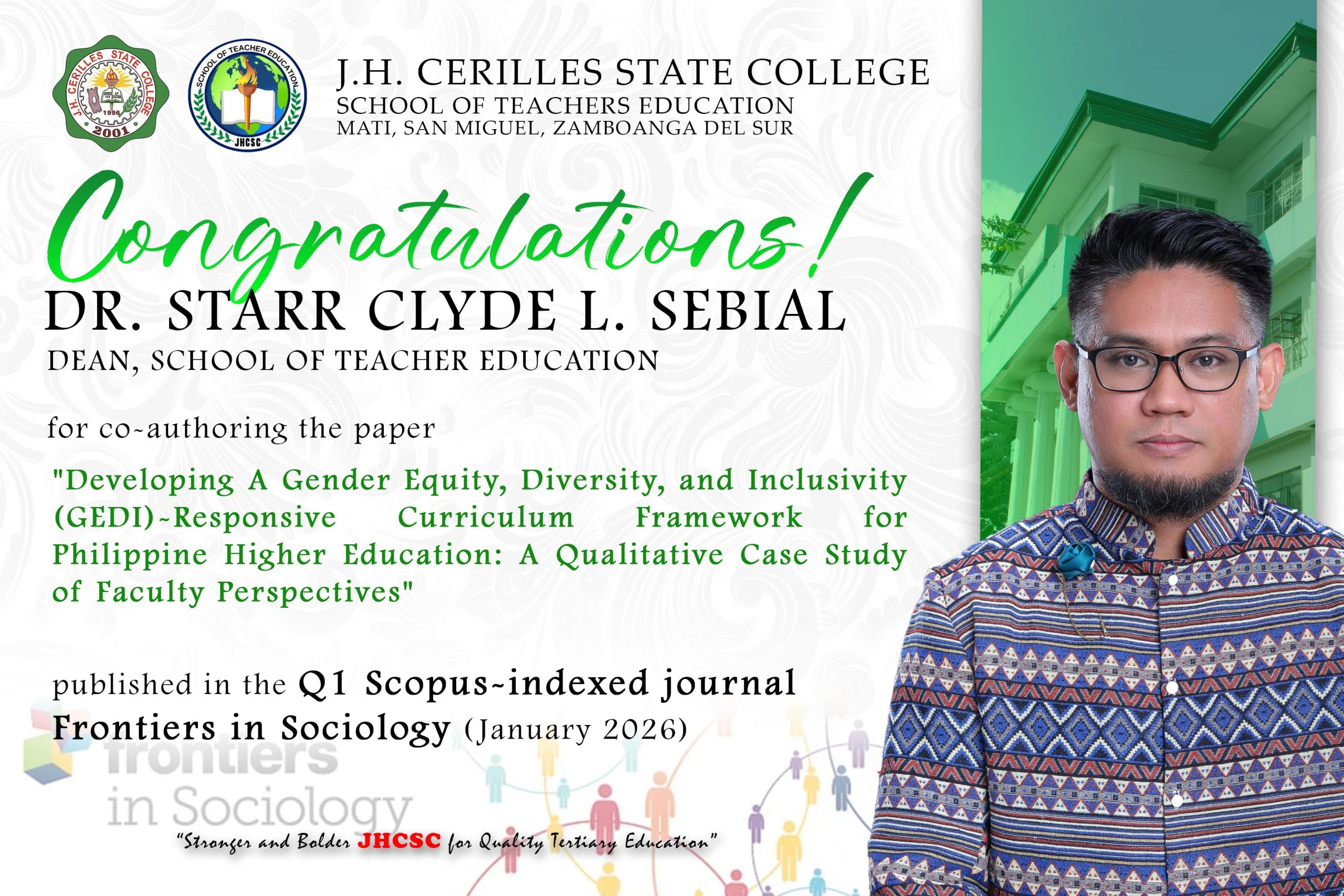
The J.H. Cerilles State College (JHCSC) proudly celebrates a significant research milestone as Dr. Starr Clyde Lumanta Sebial, Dean of the School of Teacher Education (STE), and his co-authors published a scholarly article in the Q1 Scopus-indexed journal Frontiers in Sociology (January 7, 2026). This achievement reflects JHCSC’s strong commitment to high-impact research and to advancing inclusive and equity-driven education in the Philippines.
The study, titled “Developing a Gender Equity, Diversity, and Inclusivity (GEDI)-responsive curriculum framework for Philippine higher education: a qualitative case study of faculty perspectives,” examines how GEDI principles are understood and implemented within higher education curricula. While GEDI is widely recognized and often embedded in institutional policies, the research reveals that its integration in actual teaching and curriculum design frequently remains symbolic rather than transformative.
Employing a qualitative research design, the study gathered insights from 19 Filipino faculty members across selected higher education institutions in the Philippines. Based on these perspectives, the authors proposed a four-layer GEDI-Responsive Curriculum Framework that integrates intersectionality, contextual relevance, accountability, and authentic practice across institutional, programmatic, and classroom levels. The framework emphasizes the development of measurable competencies, such as empathy, critical gender consciousness, and socially responsive teaching practices, while aligning local curriculum reforms with the global Sustainable Development Goals.
The study also identifies important gaps and directions for future research. Since the findings are context-specific to selected Philippine regions, broader validation is needed. The authors recommend expanding geographic coverage, strengthening representation of underrepresented groups—such as Indigenous Peoples and disability-specific programs—and piloting systematic feedback mechanisms to evaluate the framework’s sustainability and applicability across diverse higher education contexts.
This Q1 Scopus-indexed publication further strengthens JHCSC’s growing reputation in research excellence and curriculum innovation. It highlights the institution’s continuing efforts to bridge policy and practice, promote inclusive education, and contribute meaningful, locally grounded solutions to global conversations on equity and social justice in higher education.
Soar high, J.H. Cerilles State College!
“Stronger and Bolder JHCSC for Quality Tertiary Education”